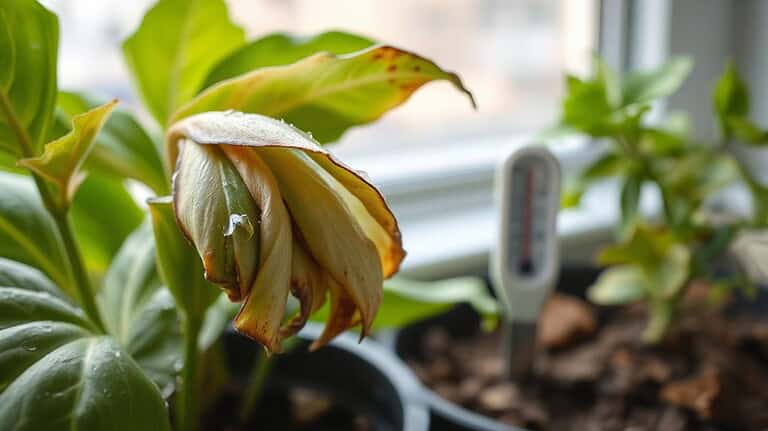
Why Are My Tomato Leaves Curling Upward?
You’re seeing those tomato leaves curl upward because the plant is basically trying to roll up a tiny, sun‑shielding tent when it’s too hot, dry, or nutrient‑off‑balance, and sometimes a sneaky whitefly or a stray herbicide spray can join the party too—think of it like a camping trip where you’re battling heat, bugs, and a leaky tent, only the tent is your leaf; if you keep the soil moist, give the vines a shade cloth, and check for pests, the curls will start to relax, and you’ll soon discover even more tricks to keep your garden happy.
TLDR
- Heat and water stress cause turgor loss, making leaves curl upward to protect against excess moisture.
- Viral infections (e.g., TYLCV) transmitted by whiteflies produce patchy yellowing and upward leaf curling.
- Herbicide drift creates rapid, uniform leaf twisting and cupping across multiple plants.
- Nutrient imbalances, especially excess nitrogen or potassium deficiency, lead to inward curling and yellowing.
- Inconsistent soil moisture from irregular watering amplifies stress‑induced curling; consistent drip irrigation and mulch help prevent it.
What Causes Tomato Leaf Curl? – Quick Overview

Ever wonder why your tomato leaves suddenly start curling like a tiny tent? You’re probably dealing with viruses like TYLCV, spread by whiteflies, causing patchy yellowing and stunted growth, or nutrients off‑balance—potassium or magnesium gaps give uniform chlorosis.
Pests such as broad mites or aphids inject toxins, while herbicide drift mimics viral twists.
Spotting patterns helps you protect the garden and your neighbors. Whitefly‑transmitted TYLCV can cause severe leaf curl and stunting within three weeks of infection.
How Heat and Sun Exposure Trigger Tomato Leaf Curl?
Why does your tomato plant suddenly look like it’s trying to roll up a tiny yoga mat? When the mercury climbs past 90 °F, its stomata gulp water faster than roots can supply, so cells lose turgor and the leaves curl upward to hide from the blazing sun, just like you’d pull a tent shade shade cooling.
Excessive UV burns the surface, thickening it, while heat‑stressed varieties roll their older leaves first, conserving moisture and protecting the plant’s “camping gear” until cooler breezes return. High daytime temperatures and cool nights can also disrupt normal plant functions and lead to stress responses like leaf curl, especially when soil moisture is inconsistent.
When Is Lack of Water the Tomato Leaf‑Curl Culprit?

After you’ve seen those leaves roll up like a tiny tent when the sun’s blasting down, you’ll notice another culprit that shows up just as often: plain‑old water shortage. When the heat spikes and the soil dries, your tomatoes lose turgor, curling upward to protect themselves; water early, keep the top inch moist, mulch, and use drip irrigation so every leaf stays happy and hydrated. To avoid confusing this with other issues, check the soil surface for salt crusts or mold to know whether watering or soil management is needed.
Which Nutrient Imbalances Cause Tomato Leaf Curl?
So, which nutrient imbalances are really behind those pesky tomato leaf curls? Excess nitrogen makes leaves thick, green and inward‑curls, while potassium shortage yellow‑tints and curls them, reducing fruit. Phosphorus lack stunts growth, yellowing leaves, and calcium deficiency twists them, sometimes with blossom‑end rot. Magnesium scarcity adds yellowing stress. Test soil, switch to low‑N or high‑K fertilizers, add compost, and keep your garden thriving. Improve soil structure and address compaction first by testing and amending the soil to ensure roots can access water and nutrients, since soil imbalance can cause uneven uptake and contribute to leaf curling.
How to Tell If Curl Is From Herbicide Drift or a Virus?

You’ll notice that herbicide drift shows up fast—petioles droop within a day, new leaves cup and curl, and the whole area looks uniformly messed up, while a virus creeps in more slowly, with upward twists, yellow edges, and whiteflies buzzing underneath; so, check the timing and pattern, ask yourself if the damage is all over the garden or just near a possible spray source, and then look for those tiny insects or droplet‑shaped spots that scream “virus” versus “spray.” Cold soil can also weaken seedlings and make symptoms worse, so be mindful of soil temperature.
Herbicide Drift Symptoms
Ever wonder why your tomato leaves look like they’re trying to do a yoga pose? If you see twisted, cupped, or strappy leaves on several plants, especially new growth, think herbicide drift. 2,4‑D and dicamba cause petiole twists and cupping within days, while picloram drops petioles fast.
Spotting white necrotic marks or yellowed, stunted shoots? your spray may have drifted miles away. Check multiple species; uniform virus patterns differ.
Virus Infection Indicators
Curious how to tell whether those twisted tomato leaves are the result of a sneaky herbicide drift or a crafty virus? Look for interveinal yellowing on young leaves, patchy spots across the garden, and stunted, bushy growth that feels like a bad camping trip without a tent—if leaves curl upward, the plant’s height shrinks, and you see reduced fruit set, it’s probably a virus, not drift.
Diagnostic Comparison Tips
So, how can you tell whether those tomato leaves are doing a yoga‑like twist because of a sneaky herbicide drift or because a crafty virus has set up camp? Check sudden, uniform curling on new growth, drooping petioles, and stem bending—herbicide clues—versus mottled patches, irregular rolling, and gradual spread—virus signs. Compare timing, pattern, and nearby spray history.
Herbicide‑Induced Tomato Leaf Curl: Appearance and Identification

You’ll notice the leaves taking on a rubber‑shaped curl that stays bent like a tiny tent, and that deformation doesn’t just snap back—it hangs around for days, reminding you of a stubborn camping tarp that won’t smooth out after a windy night.
Have you ever tried to straighten a rope that’s been twisted by a storm? That’s basically what the herbicide does to the leaf tissue, locking the shape in place and making the plant look like it’s permanently flexing for a photo‑op.
Keep an eye on those persistent curls, because they’re a dead‑giveaway sign you’re dealing with chemical injury rather than a fleeting virus.
Many landscape plants showing similar persistent deformation can include nearby shrubs like winter-blooming shrubs, which also reveal chemical damage through distorted foliage and blooms.
Rubber‑Shaped Curl
Ever wondered why your tomato leaves suddenly look like stretchy rubber bands curling around themselves? That rubber‑shaped curl usually means a herbicide drift, like picloram or aminopyralid, hit your garden. The new growth cups, petioles droop, and stems twist, making leaves look like elastic loops. Spotting this early helps you protect neighbors’ crops, so keep an eye out and act fast.
Persistent Leaf Deformation
What does it feel like when your tomato leaves start looking like they’ve been stretched into tiny tents? You spot drooping petioles, new growth curling like tiny tents, and stems twisting or bending horizontally—classic herbicide fingerprints. Picloram, aminocyclopyrachlor, aminopyralid, or 2,4‑D each leaves these quirks, from stringy petioles to brown stem lesions, helping you pinpoint the culprit quickly.
Viral Infections That Mimic Tomato Leaf Curl – What to Look For
Even if you’ve never set foot in a greenhouse, you’ve probably seen a tomato plant with its leaves curling like a little tent, and that can be a sign of several sneaky viruses that love to masquerade as the classic Tomato Yellow Leaf Curl Virus.
Look for TYLCV’s whitefly‑spotted patches, Curly Top’s brittle, mottled growth, Tomato Apical Stunt’s narrow, crinkled leaves, Potato Leafroll’s rounded leaflets, and Mosaic’s fern‑like, dark streaked foliage, then act fast to protect your garden crew.
Step‑by‑Step Diagnosis of Tomato Leaf‑Curl Stressors

After talking about those sneaky viruses, let’s roll up our sleeves and figure out what’s really making your tomato leaves cup like tiny tents. First, inspect lower leaves for thick, leathery green rolls—no yellowing. Then check watering habits, nitrogen levels, and phosphorus. Look for drought or heat stress signs, and verify herbicide drift. Finally, test soil pH and nutrients, and note any pruning or root damage clues.
What Immediate Remedies Help Heat‑Induced Tomato Leaf Curl?
Ever wondered why your tomato leaves start looking like tiny tents when the sun’s blazing? Snap on a 30‑40 % shade cloth during scorching afternoons, then mulch with straw or grass to keep soil cool. Water deeply in the evening, letting roots soak before night, and set up a fan or open vents for breezy airflow. Check leaves after watering—if they uncurl, you’ve nailed the quick fix.
Long‑Term Strategies to Prevent Water‑Stress Tomato Leaf Curl

You’ll notice that setting up a moisture‑consistent irrigation schedule is like planning a road‑trip where you never run out of gas—drip lines or ollas keep the water flowing steadily, so your tomatoes stay hydrated even when the sun’s blazing.
Adding a thick layer of mulch—think of it as a comfy sleeping bag for the soil—locks in moisture, reduces evaporation, and lets you sleep soundly at night knowing the roots aren’t thirsty.
Combine these two tricks, and you’ll have a garden that feels as relaxed as a campsite after a perfect sunset, with leaf curl becoming a thing of the past.
Moisture‑Consistent Irrigation
Ever wondered why a tomato plant’s leaves sometimes curl up like they’re trying to hide from a sudden rainstorm?
You keep soil moist by watering 2‑3 times weekly, or daily in heat, using drip lines that soak 6‑8 inches deep, checking moisture with a finger or meter, and adjusting for wind, temperature, and growth stage, so roots stay happy and leaves stay flat.
Mulch‑Enhanced Soil Retention
After you’ve nailed the watering schedule, the next game‑changer is covering the soil with a good layer of organic mulch—think of it as giving your tomato plants a cozy blanket that keeps them warm at night and cool in the heat, just like a perfect campsite tent.
Spread 2‑4 inches of straw or shredded leaves, leave a 2‑inch gap around stems, and watch moisture stay steady, weeds disappear, and leaf curl vanish.
Overall
You’ve got the tools now, so grab your watering can, shade those seedlings, and keep an eye on the sun like a campsite scout. Remember, a little extra water on a hot day, a quick nutrient tweak, and a dash of pest‑check can turn those curled leaves into happy, flat ones. And if a virus shows up, treat it like a surprise rainstorm—act fast, stay calm, and your garden will bounce back stronger than ever. Happy growing!