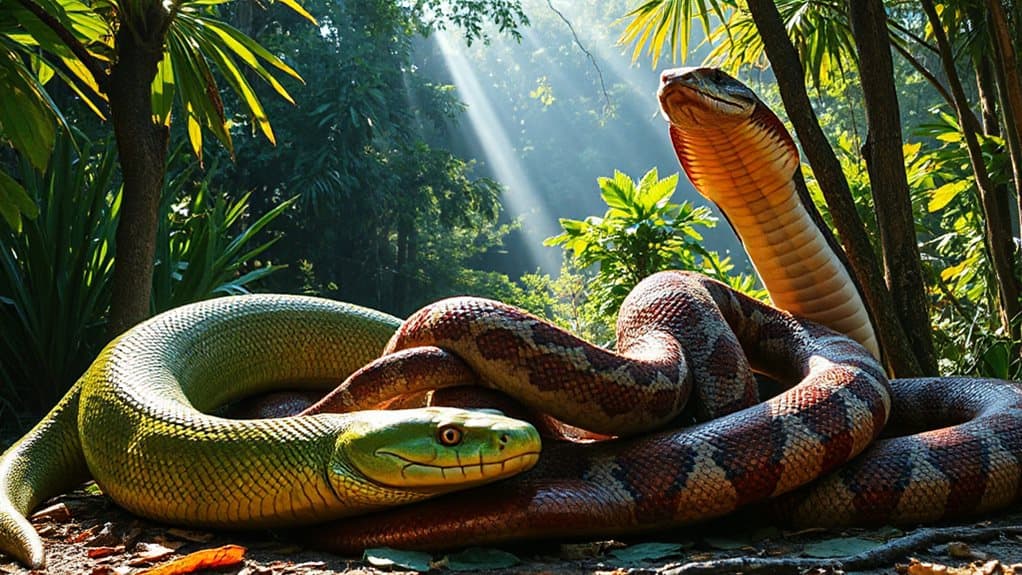
Anaconda vs Python vs Boa: Who’s the Top Predator?
You’ll find the green anaconda tops the pack because its massive girth delivers a crushing squeeze of up to 90 PSI, its water‑loving ambush lets it strike unseen in swampy depths, and its jaws can gulp down deer‑size prey, while the reticulated python’s tree‑climbing agility and the boa’s forest‑floor stealth are impressive but less forceful; curious about their heat‑sensing pits, egg‑holding tricks, and how each species balances size with habitat, keep going and explore the full showdown.
TLDR
- Green anacondas generate the highest squeeze pressure (~90 PSI), far exceeding pythons (~14 PSI) and boas, giving them superior crushing power.
- Anacondas’ aquatic ambush strategy and near‑submerged posture provide stealth advantages over land‑based pythons and boas.
- Their live‑birth reproduction protects embryos, while pythons lay eggs and boas hatch in sacs, affecting population dynamics.
- Anaconda jaws can stretch to swallow large mammals such as deer or jaguar, surpassing the prey size limits of most pythons and boas.
- Overall, the anaconda’s combination of massive girth, extreme squeeze force, and aquatic stealth makes it the top predator among the three.
Anaconda vs Python vs Boa: Size & Weight Comparison
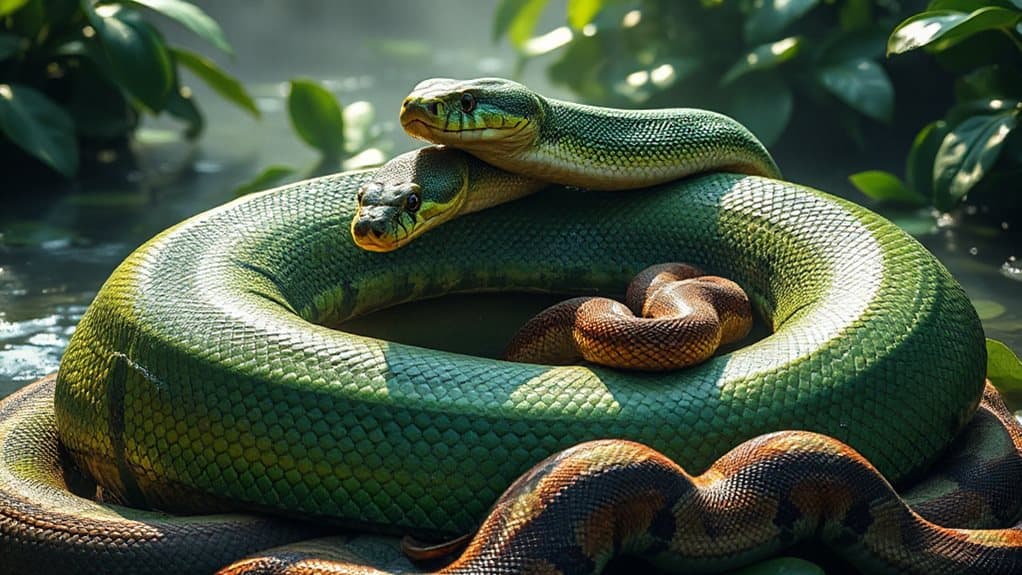
If you’ve ever imagined trekking through a rainforest or setting up camp by a river, you can envision three massive, slithering giants that could totally steal the show: the green anaconda, the reticulated python, and the boa constrictor. The homeowners association may even regulate parking and vehicle rules in shared spaces, so it’s important to know your HOA towing authority.
You’ll notice the python tops length charts at ten meters, while the anaconda dominates weight at 227 kg, and the boa sits middle‑ground, lean yet sturdy, perfect for teaching friends about nature’s balance. Anacondas are viviparous and give birth to live young after internal egg development.
Habitat Advantages for Each Constrictor
When you set up camp near a lazy, sun‑drenched swamp in the Amazon, you’ll quickly see why the green anaconda treats water like a personal playground—its eyes and nostrils sit right on top of its head, letting it stare straight ahead while almost fully submerged, and its massive, muscular body lets it pull prey down with a single, powerful lunge that would make any fisherman jealous.
You’ll love how pythons swing between trees and dunes, hunting birds or rodents wherever they roam, while boas dominate forest floors and scrublands, using their weight and agility to ambush land‑bound meals, each thriving where they’re most comfortable.
Reproductive Strategies & Lifespan Differences
After you’ve soaked up the swamp’s humid vibes and watched an anaconda glide like a living submarine, it’s time to see how these reptiles actually make more of their kind.
You’ll notice pythons lay hard eggs and coil to warm them, while anacondas keep embryos inside, giving live births, and boas hatch inside transparent sacs.
Each method balances temperature control, predator safety, and parental effort, shaping their lifespans and population bursts.
Hunting Tactics: Water Ambushes vs Tree Strikes
Image yourself crouched on a mossy riverbank, the air thick with humidity, and you’ll see why anacondas dominate water ambushes while pythons and boas prefer tree strikes.
You feel the anaconda’s eyes and nostrils on top of its head, letting it hide almost fully submerged, sensing warm prey through heat pits and vibrations.
Meanwhile, you imagine a python perched, motionless, tail twitching, waiting for a curious bird to wander close enough for a sudden, precise strike.
Raw Power: Squeeze Force, Bite Strength & Prey Limits
You’ll notice the anaconda’s 90 PSI squeeze dwarfs the python’s modest 14 PSI, meaning the former can crush a deer’s heart while the latter barely rattles a human’s pulse, and that’s why you should image anacondas as the heavyweight champions of constriction.
Do you ever wonder how a 100‑tooth bite, which mainly just hooks the prey, fits into this raw‑power scene?
Extreme cold can affect equipment functionality, so be mindful of tank freezing risks in frigid conditions.
Squeeze Pressure Comparison
Imagine this: you’re out on a weekend camping trip, the night sky glittering above, and you hear a rustle in the underbrush—suddenly you realize you’re face‑to‑face with the ultimate squeeze champion.
You feel the anaconda’s 90 PSI crush, six‑and‑a‑half times stronger than a python’s 14 PSI, both stopping blood flow instantly, yet the anaconda’s massive weight and speed give it a clear pressure edge.
Bite Force Metrics
When you’re huddled by the campfire and hear a rustle, you might wonder whether the snake’s bite could rival a superhero’s punch, but the reality is that anacondas, pythons and boas all rely on their crushing hugs more than their teeth.
Anaconda jaws may hit ~900 PSI, yet that’s still softer than a lion’s bite; pythons and boas lack solid bite data, focusing on constriction.
Maximum Prey Size
Visualize yourself sitting by a crackling campfire, the night air buzzing with insects, and you hear a low rustle in the underbrush—what’s the biggest creature that could actually swallow something as large as a small deer or even a jaguar?
You’ll find the green anaconda tops the list, crushing up to 550 lb, stretching jaws wide enough for deer, jaguar, even a capybara, while reticulated pythons lag behind in mass despite similar length.
Sensory & Escape Tools: Heat‑Sensing, Diving & Biting
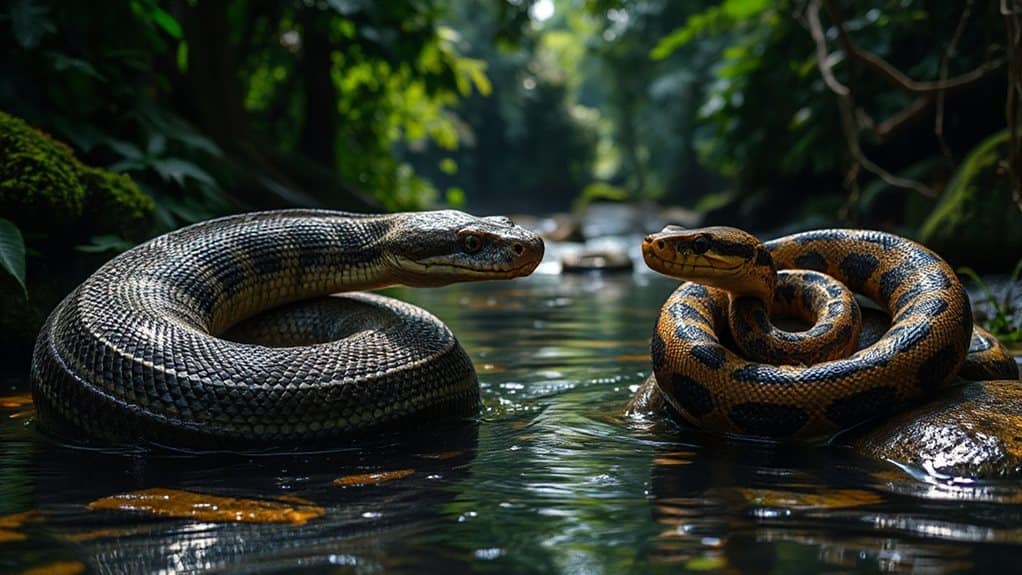
Even before you set up your campsite, envision how an anaconda, a python, and a boa each turn their bodies into high‑tech survival kits: they’ve got heat‑sensing pits that act like built‑in night‑vision cameras, allowing them to spot a warm‑blooded mouse or rabbit in total darkness, and they pair that with a flicking tongue that gathers scent particles for the Jacobson’s organ—so you can practically hear the “click‑click” of their tongues as they sniff out dinner.
You’ll love how anacondas hold breath ten minutes, diving deep to vanish when threatened, while pythons and boas rely on sharp tongues and vibration‑sensing to ambush prey, and each strikes bite‑first, using sturdy fangs before coiling.
Letting water run until it clears can help determine if cloudiness is caused by air bubbles, which are typically harmless.
Which Constrictor Wins the Strength‑and‑Survival Test?
You’ve already imagined those heat‑sensing pits and flicking tongues turning each snake into a night‑vision gadget, so let’s see which of the three heavy‑hitters actually outmuscles the others when the survival stakes get real.
The anaconda’s massive girth and 300‑lb grip beat a same‑weight python, while boas, though lighter, tighten faster, causing organ failure in seconds; yet the anaconda’s aquatic stealth and sheer size give it the ultimate edge in strength‑and‑survival.
And Finally
You’ve seen how Anaconda’s massive bulk and water‑loving ambushes make it a heavyweight champ, while Python’s sleek agility lets it slip through any terrain and Boa’s steady grip gives it a reliable, all‑rounder vibe. So, which one wins the strength‑and‑survival showdown? Honestly, it depends on the mission—if you need raw power, go Anaconda; if you crave versatility, pick Python; if you want consistent, dependable strength, Boa’s your buddy. Pack your gear, pick your predator, and enjoy the wild ride!